

Safeguarding the Fossil Fuel Industry: How Carbon Offsetting Undermines Australia’s Flagship Climate Policy
Please join the Melbourne Centre for Law and the Environment for this seminar on ‘Safeguarding the Fossil Fuel Industry: How Carbon Offsetting Undermines Australia’s Flagship Climate Policy’, presented by Associate Professor Fergus Green and chaired by Professor Rebecca Nelson.
The Federal Government is about to review its key climate policy for reducing emissions from large industrial polluters outside of the electricity sector—the Safeguard Mechanism. The scheme allows big emitters to meet their obligations using an unlimited amount of so-called ‘offsets’, but critics argue those offsets lack integrity. Consequently, questions are being asked about whether the scheme is actually reducing emissions, or just allowing fossil fuel companies to keep polluting.
In this lecture, Dr Fergus Green, Associate Professor at University College London and Honorary Senior Fellow at the Melbourne Law School will share insights from his recent report for The Australia Institute, and his ongoing research and advocacy, on this subject. The session will explore how the Safeguard Mechanism is failing to drive the structural decarbonisation of Australia’s industries, the problems with so-called offsets, and the international legal and reputational risks for Australia. Fergus will also share his experiences of advocating for law reform on this topic in Canberra
Light refreshments provided from 3.45pm.
Online attendance also supported.
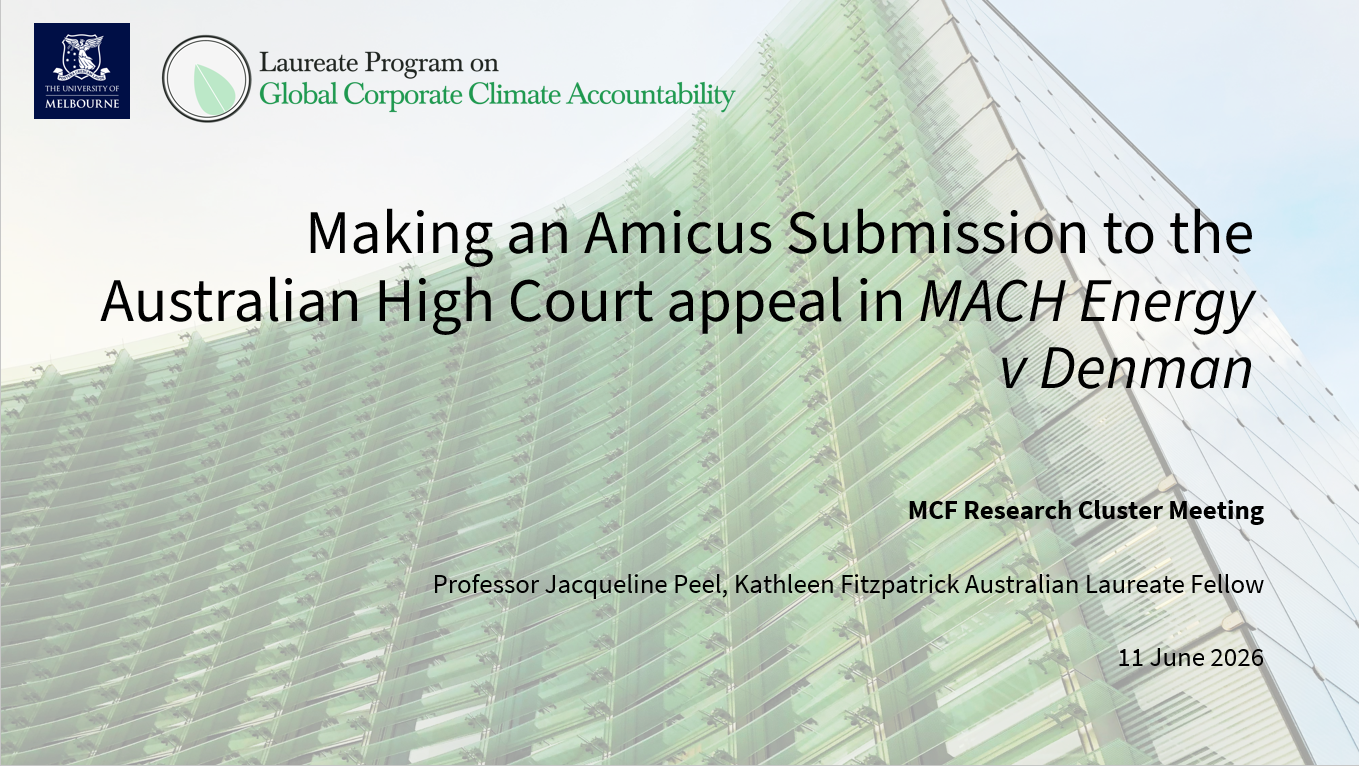
Making an Amicus Submission to the Australian High Court appeal in MACH Energy v Denman
Professor Jacqueline Peel presents at the Melbourne Climate Futures Research Cluster Meeting about the Amicus submission to the High Court of Australia hearings in its first ever climate case - MACH Energy v Denman.
This case raises questions about the types of climate impacts that need to be considered by authorities when assessing a fossil fuel project and the extent of responsibility proponents bear for impacts associated with their downstream or scope 3 emissions (often the lion's share of a project's emissions where the fossil fuel extracted is intended for export and consumption overseas).
This is a topic with which many courts have engaged in the last few years, including courts in the UK, US, the Netherlands, New Zealand, Germany and Switzerland, as well as the International Court of Justice in its landmark climate Advisory Opinion.

International Law, Directors Duties, and Corporate Climate Accountability
Engaging expert panel discussion on a landmark international decision
The International Court of Justice (ICJ) Advisory Opinion on Climate Change, delivered last year, ruled that nations must act to combat climate change, including by regulating fossil-fuel emitting activities in their jurisdictions whether conducted by public actors or private entities like corporations. This landmark international decision has wide-ranging implications for the corporate sector in Australia and globally.
This panel session, jointly convened by the Laureate Program on Global Corporate Climate Accountability and Climate Integrity, will discuss some of the potential implications of the ICJ Advisory Opinion for companies, directors, investors and regulators, including:
What the international climate decision means for Australia
What domestic regulatory reforms could be required for Australia to meet its international obligations
How the ICJ opinion has heightened climate-related risks for fossil fuel and other emissions-intensive companies and may raise the standard of care expected of directors of those companies
The role that corporations, directors and investors could play in regulatory reform and raising ambition for limiting global warming to 1.5 degrees.
Speakers:
Professor Jackie Peel, Laureate Fellow on Global Corporate Climate Accountability and world-leading expert in international climate law and climate litigation.
Zoe Bush, barrister at Banco Chambers; adjunct senior lecturer at University of Western Australia, and lead instructing solicitor in contested matters before the High Court, Federal Court, Supreme Court of Western Australia and lower courts.
Simon O’Connor, Director of the Sustainable Finance Hub, Melbourne Climate Futures at the University of Melbourne and non-executive director of Bank Australia.
Professor Margaret Young, ARC Future Fellow, Director of the Institute for International Law and the Humanities at Melbourne Law School, and Director of Studies of the International Law Association (Australian branch).
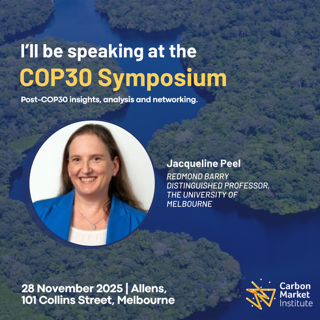
Post-COP Symposium - Carbon Market Institute
Program Overview
This event will unpack COP30 outcomes, analyse implications for Australia, and explore what comes next for policy, markets and investment.
Session 1: Advancing International Cooperation on Carbon Markets
Session 2: Policy Enablers to Achieve Australia’s 2035 NDC
Session 3: Implications for Australian Business and Investment
Concludes with: CMI’s End-of-Year Networking Function
COP30 will bring world leaders, NGOs, businesses and civil society to Belém, Brazil from 10–21 November 2025 — the first time a COP is hosted in the Amazon region. COP30 will highlight the critical role of tropical forests, protecting and restoring ecosystems, and nature-based solutions. This significant global summit will focus on accelerating climate action, updating national climate plans (NDCs), and reviewing progress on the Paris Agreement commitments, particularly the goal of limiting global warming to 1.5c. Touted as an “implementation and action” COP, its goal is to translate Global Stocktake (GST) outcomes into concrete climate action.
With a strong focus on translating the Global Stocktake into action, key themes include:
The energy transition
Climate finance
The launch of carbon markets
The role of nature and local actors in tackling climate change
Registration Fees
$175 + GST — CMI Member
$225 + GST — Non-Member

Belém and beyond: Reflections on COP30 and what it means for COP31
Join ICEDS and the COP Universities Alliance for an in-depth webinar unpacking the outcomes of COP30 in Belém and what they mean for the road ahead.
Hear directly from climate experts who were on the ground at COP30 as they share first-hand reflections, analysis, and lessons for Australia’s preparations for COP31. Laureate Fellow Professor Jackie Peel joins expert colleagues from the program at this event hosted by ANU Institute for Climate, Energy & Disaster Solutions and the COP Universities Alliance.
This event will be fully online and a recording will be made available after the event.

Holding Corporate Polluters Accountable: Science, Impact Attribution, and the Law
Around the world, communities severely impacted by climate change are developing lawsuits to sue fossil fuel companies for compensation. One of the latest efforts is by Filipino survivors of Typhoon Odette who served Shell with a letter of action threatening litigation to recover damages from the oil major. This session will address emerging scientific, social science and legal research efforts for holding corporate polluters accountable for the climate impacts of their emissions. It will also canvas how universities around the world can collaborate on research and knowledge exchange to take forward the goal of ensuring corporate climate accountability.

Corporate net zero accountability: how do we get there?
How can governments combat greenwashing and enhance high-integrity corporate and financial climate efforts? What tools and mechanisms can help move beyond target-setting towards implementation? Accountability mechanisms are an emerging area of climate policy that seek to turn climate commitments into net zero delivery. Building on insights from the Taskforce on Net Zero Policy’s second report, this panel will discuss key policy developments and regulatory trends.
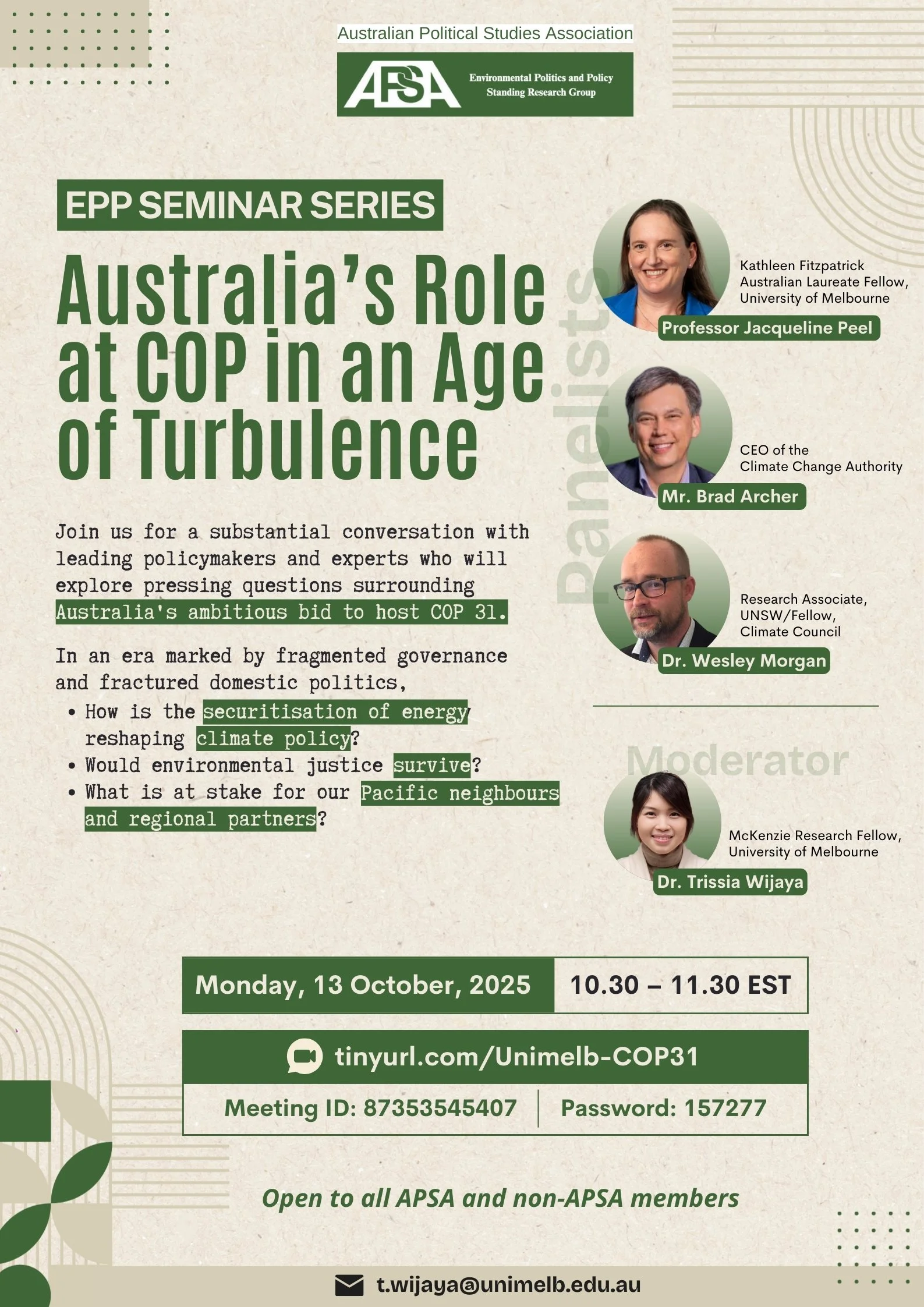
Australia's Role at COP in an Age of Turbulence
The Australian Political Studies Association invites you to join a conversation with leading policymakers and experts who will explore pressing questions surrounding Australia’s ambitious bid to host COP31.
In an era marked by fragmented governance and fractured domestic politics,
How is the securitisation of energy reshaping climate policy?
Would environmental justice survive?
What is at stake for our Pacific neighbours and regional partners?
Panelists:
Prof. Jacqueline Peel, Kathleen Fitzpatrick Australian Laureate Fellow in Global Corporate Climate Accountability, University of Melbourne
Mr. Brad Archer, CEO of the Climate Change Authority
Dr. Wesley Morgan, Research Associate, UNSW Institute for Climate Risk & Response
Moderator: Dr. Trissia Wijaya, Research Fellow, University of Melbourne
Enquiries: t.wijaya@unimelb.edu.au
Meeting ID: 87353545407 | PW: 157277
Climate Liability Claims and Presenting Expert Evidence in Court
2025 has seen significant developments in climate litigation. The Federal Court ruled that the Australian Government does not have a duty of care to protect Torres Strait Islanders from climate change, only a week prior to the International Court of Justice handed down its momentous Advisory Opinion on the Obligations of States in respect of Climate Change.
At the heart of these sorts of claims for climate-related damages against corporate and government actors is attribution science. How the court uses this science is fundamental to the success – or not – of the case.
In this conversation, we will discuss the latest trends and what they mean for climate liability claims in the future, while examining the process of presenting expert evidence in court.
Presenters:
Emrys Nekvapil SC (practicing counsel at the Victorian Bar with extensive practice in climate change litigation)
Professor Jacqueline Peel (Laureate Fellow on Global Corporate Climate Accountability)
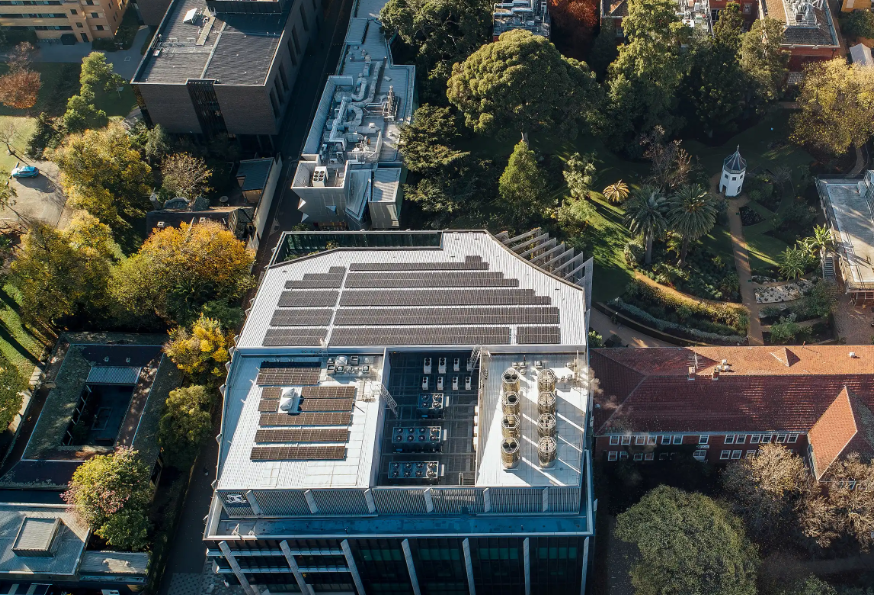
Sustainability Week: Ask Me Anything Panel (Climate Leadership)
As part of Sustainability Week, we invite you to join our Ask Me Anything panel — an open and inclusive forum designed to spark meaningful dialogue around pressing sustainability issues.
This session will be centred around Climate Leadership and brings together a diverse group of experts and practitioners working across this sector at the University.
Anyone is welcome as this is your opportunity to ask questions, share ideas, and gain insights from those driving change across the sector.
Panellists:
Jacqueline Peel, Redmond Barry Distinguished Professor of Climate Law, The University of Melbourne
Ben Neville, Deputy Director of Melbourne Climate Futures, The University of Melbourne
Chris Dixon, Sustainability Strategy Analyst, The University of Melbourne
Sarah-Kay Coulter, Lecturer in Indigenous Studes, The University of Melbourne
Online event: a zoom link will be sent out prior to the event.
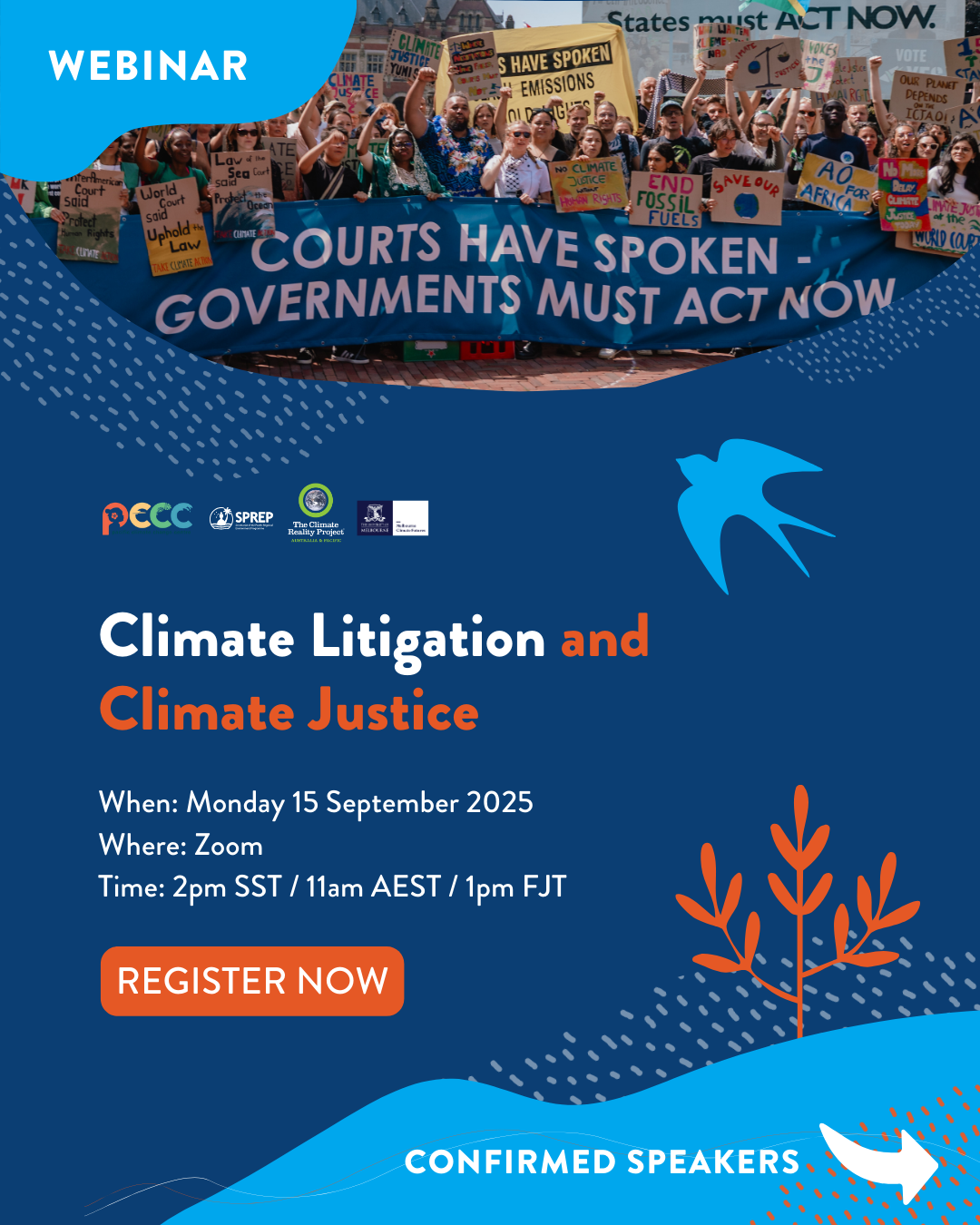
Climate Litigation and Climate Justice
Hear from Vishal Prasad, Director Pacific Islands Students Fighting Climate Change, and Roanna McClelland, ARC Laureate Research Fellow in the Laureate Program on Global Corporate Climate Accountability based at Melbourne Law School, in the upcoming webinar ‘Climate Litigation and Climate Justice.’
Together, we will explore the role of climate litigation in advancing climate justice, creating accountability for major contributors to the climate crisis, and building partnerships with those most affected.
We invite Climate Reality Leaders, climate advocates, and community members across the region to join this important conversation.
The Climate Commons webinar series is a proud collaboration between the Pacific Climate Change Centre, hosted at Secretariat of the Pacific Regional Environment Programme (SPREP), and The Climate Reality Project - Australia & Pacific, hosted at Melbourne Climate Futures.

Litigating Climate Change: Recent Developments
Collaboratively presented by the Commercial Bar Association (Climate Change Section) of the Victorian Bar, the Australian and New Zealand Society of International Law, and the Laureate Program on Global Corporate Climate Accountability.
Professor Jacqueline Peel and Associate Professor Jolene Lin are the authors and winners of the 2025 ANZSIL Book Prize for their work Litigating Climate Change in the Global South and they will discuss, in conversation with Tomo Boston KC:
recent developments in climate change litigation at the international, regional and national levels, including the Advisory Opinions of the International Court of Justice and Inter-American Court of Human Rights.
the potential impact of those recent developments on climate change litigation in Australia
the relationship between climate change litigation and the Paris Agreement
future trends in climate litigation
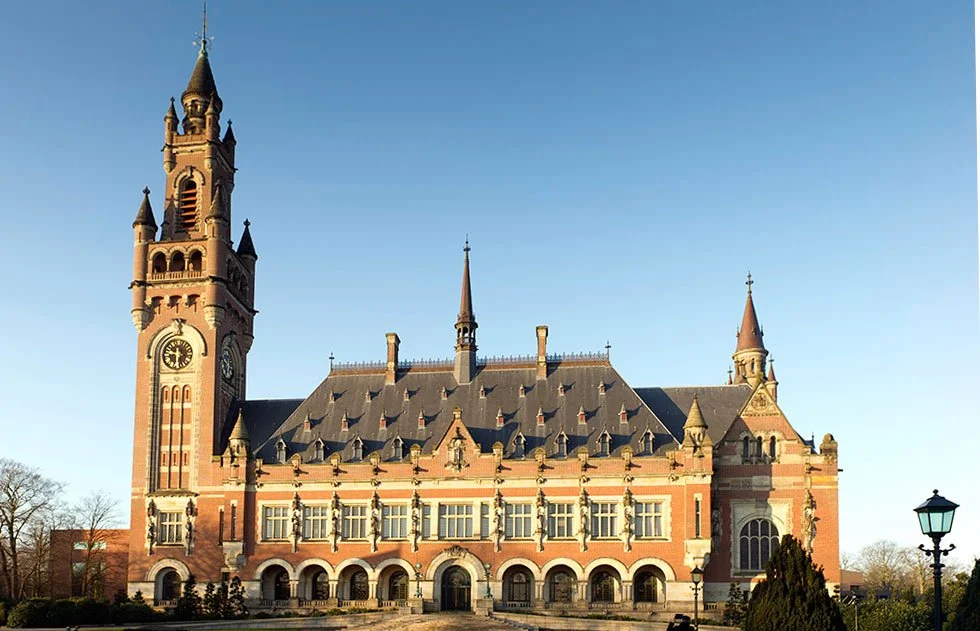
The ICJ’s Climate Advisory Opinion – Initial Reflections and Responses chaired by Professor Margaret Young
Melbourne Law School experts Dylan Asafo, Rohan Nanthakumar, Professor Jackie Peel and Professor Margaret Young will discuss the recent ICJ’s Advisory Opinion and its implications for international law.

Global trends in climate litigation 2025: report launch
Join the launch of the Global Trends in Climate Change Litigation 2025 Snapshot Report - now in its seventh year. This influential report provides an annual overview of key developments in climate litigation worldwide and identifies emerging trends shaping the future of climate law and governance.
Join in-person or register to watch the event online at LSE Live. LSE Live is the home for the London School of Economics live streams, allowing you to tune in and join the global debate wherever you are in the world. If you can't attend live, a video will be made available shortly afterwards on LSE's YouTube channel.
Hosted by the Grantham Research Institute on Climate Change and the Environment as part of London Climate Action Week.
Photo by Kaboompics.com via Pexels.

Litigating Climate Change and Human Rights in Australia: Perspectives of a judge, an advocate and an academic
In April, Environmental Justice Australia submitted a human rights complaint to the United Nations Special Rapporteur on Climate Change on behalf of nine young people from across Australia collectively called ‘Generation Justice’. This international procedure is one among several legal avenues for raising concerns about the human rights impacts of a changed climate in Australia. Join Justice Rachel Pepper (Land and Environment Court of NSW), Hannah White (Environmental Justice Australia) and Professor Jacqueline Peel (Melbourne Climate Futures) in conversation with Dr Alice Palmer to discuss some of the pros and cons of litigating climate change in Australia through a human rights lens.