
Climate Extreme: London Climate Action Week 2026
During an unprecedented heatwave, the Laureate Program on Global Corporate Climate Accountability attended London Climate Action Week in June 2026. The significance of attending the vast array of events held to galvanize climate action during a climate extreme was not lost on Research Fellows Roanna McClelland and Suzanne Varrall, who share their first-hand experience of attending London Climate Action Week 2026 below.
Events on extreme heat were cancelled due to the extreme heat. Transport and infrastructure showed the strain early, with tubes halted, and traffic and flights disrupted. Schools were closed. We felt the physical pressure of inadequately air-conditioned accommodation and the challenge of commuting and working when levels of physical discomfort were high. The severe temperatures, in the high 30s and humid, came with health risks and even deaths. While we were fortunate to have cool spaces to retreat to, it was clear that London is not a safe place to be when the temperature rises, especially for children, the elderly, those with mobility challenges and those without access to air-conditioned spaces.
Against that backdrop, the events held during London Climate Action Week took on additional significance, where attendees could not ignore the very present threat from the changing climate. The diverse schedule – some 1000 events over 9 days – had a distinct 'investment' lens, with events often held in the 'big end' of town and focused on transition planning and corporate climate accountability. Participants sweltered, and speakers used hand-held fans to try to keep cool. Despite the challenges, events were well-attended (often over-subscribed) and drew people from the private and community sectors together.
On Monday 22 June, Suzanne commenced the week at the ‘2026 Stocktake: Climate Change Litigation and Human Rights’ breakfast event hosted by the Net Zero Lawyers Alliance and Business Human Rights Lawyers Association. Speakers discussed the current litigation landscape as well as developments on the horizon relevant for corporate responsibility. That same day, we conducted a brief side-trip to colleagues at the Lauterpacht Centre for International Law at Cambridge University for a roundtable discussion: 'Climate Talks'. Roanna had last visited Cambridge when it was covered in three feet of snow, so the contrast with sweltering temperatures was stark.
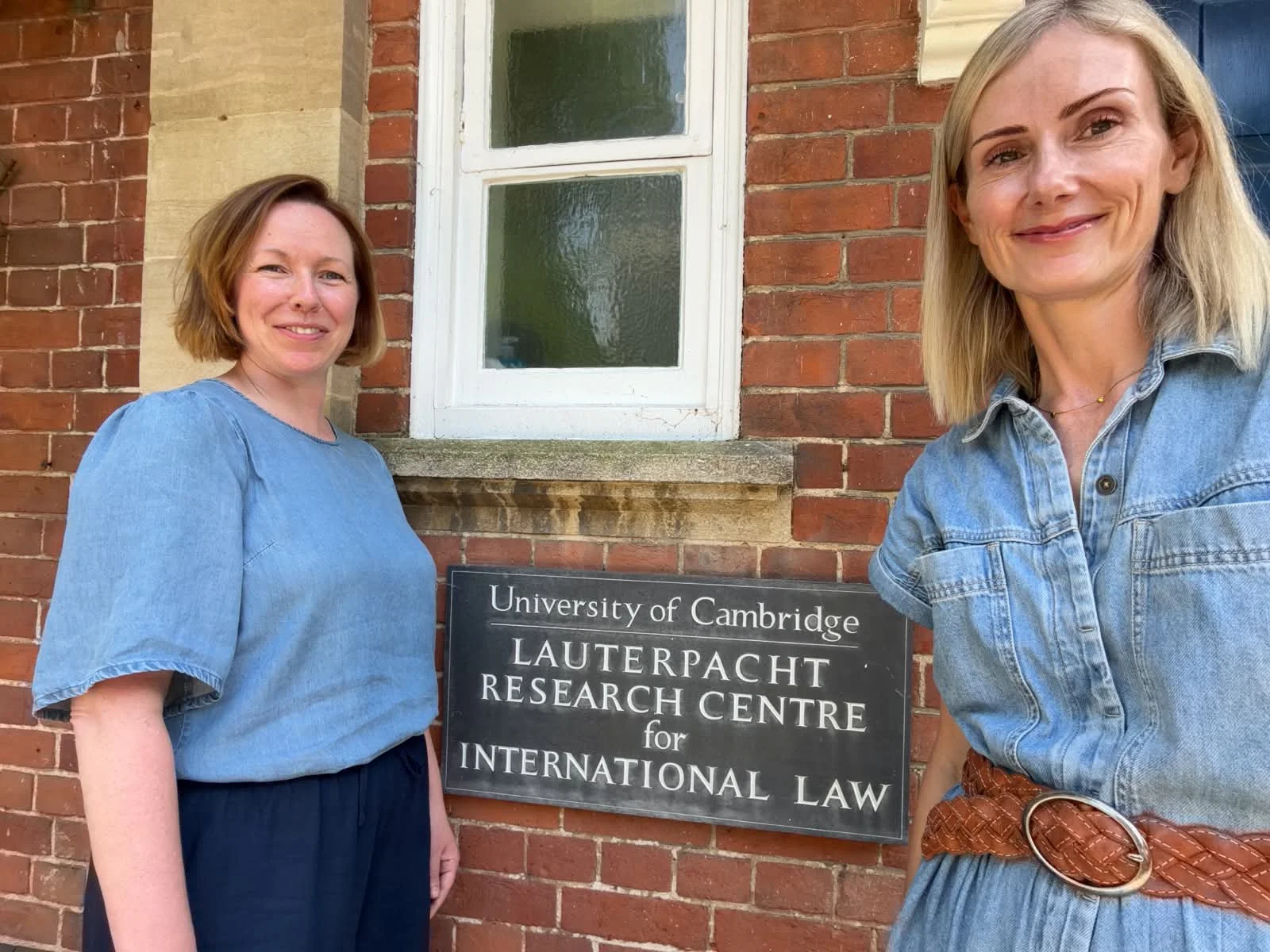
Dr Roanna McClelland and Dr Suzanne Varrall at the University of Cambridge.
On Tuesday morning, we struggled our way across the city with no tubes to attend an excellent event hosted by ClientEarth, exploring the tortious liability of banks for adverse climate impacts of projects they have financed. The panel had conducted a “thought experiment” involved in developing a mock judgment establishing liability for a hypothetical case, which will be of interest to all lawyers working in the corporate climate accountability space. A recording of the panel discussion can be accessed on YouTube.
At every event we attended, the impact of the International Court of Justice (ICJ) Advisory Opinion on Climate Change was front and centre of discussions, and so we were thrilled to be able to launch our Policy Backgrounder: Implications of the ICJ’s Climate Advisory Opinion, during the week's proceedings, which aims to help policymakers better understand the ICJ Advisory Opinion and its practical implications for policy development and implementation. In that vein, we were formally invited to and participated in the Taskforce on Net Zero Policy's high-level roundtable titled ‘Charting the Way Forward for High Ambition and Credible Transition Plans’ on Tuesday 23 June, organised by the UN Global Compact, UN Environment Program Finance Initiative (UNEP-FI), the Taskforce on Net Zero Policy and UN-supported Principles for Responsible Investment, during the UNEP-FI Global Roundtable. Here we were able to meet with UNFCCC colleagues working on the role of non-state actors in the sustainable transition to a non-carbon economy.
Also on June 23, 2026, London's legal community turned its attention to the climate crisis at two events attended by Suzanne. The Net Zero Lawyers Alliance's ‘Climate on the Books’ panel event opened with a keynote from Lord David Neuberger, former President of the UK Supreme Court, followed by speakers including Wendy Miles KC, Maurits Dolmans, and Natasha Landell-Mills examining climate change's impact on law and economics. That evening, at the Law Society Hall, the ‘Rule of Law and Role of Lawyers in Climate Change’ event opened with keynote remarks from Baroness Smith of Cluny KC, Advocate General for Scotland, and Dana Denis-Smith OBE, Deputy Vice President of The Law Society, before a panel featuring Client Earth CEO Laura Clarke and Bar Council Chair Kirsty Brimelow KC. When a former Supreme Court President and a sitting Advocate General are both talking climate in the same week, it sends a strong signal that the legal profession has stopped treating this as a side issue and that climate risk is now squarely a rule-of-law issue, not just a regulatory one.
Closing out a very busy few days, Suzanne attended the second annual ‘Climate Governance Forum 2026’ on Wednesday 24 June, hosted by the International Climate Councils Network and think tank E3G. This dynamic event featured a half-day of high-level keynotes, panels and roundtable discussions involving over 200 stakeholders from across policy, business, the law, and academia. In addition to a keynote address from Mary Robinson, the Former President of Ireland and former UN High Commissioner for Human Rights, panels discussed innovation in governance models – including climate councils, citizen assemblies, and parliamentary reforms – before breakout sessions focused on specific areas including policy engagement and adaptation governance. Overall, this large-scale forum managed to remain relatively interactive and provided a positive conclusion to our time at LCAW 2026, with inspiring contributions from youth activists and those who have dedicated the greater parts of their careers to bringing the challenge of climate change to the world’s attention.
