
Imagining new worlds: a global system of legal accountability for corporations in a changing climate
On 3 July 2026, the Laureate Program on Global Corporate Climate Accountability convened a panel at the Australian New Zealand Society of International Law (ANZSIL) Conference, held at Victoria University of Wellington's Pipitea Campus. Chaired by Professor Jacqueline Peel, the roundtable explored the emerging global legal 'ecosystem' for holding corporations to account in a changing climate.
Opening the session, Professor Peel introduced the Laureate Program's five-year effort to map the legal and regulatory landscape for corporate climate accountability, and invited the panel to imagine what a genuinely global system of accountability might look like — one that connects developments across international, transnational and domestic law. The discussion took as its starting point the International Court of Justice's recent Advisory Opinion on Climate Change, which has sharpened the focus not only on the obligations of States, but on those of the private corporate emitters they regulate.
Dr Suzanne Varrall, one of the Laureate Program’s postdoctoral research fellows, considered how the ICJ's Advisory Opinion, alongside other recent advisory rulings, is reshaping the conventional view of corporate accountability as a purely domestic concern, and what courts have said about States' duties to regulate corporate conduct. Professor Kate Miles (University of Cambridge) examined the role of international investment law, and whether it is likely to help or hinder corporate climate accountability. Dr James Every-Palmer KC (Stout Street Chambers) turned to the wave of innovative corporate climate litigation emerging in New Zealand — including Smith v Fonterra — the uptake of the ICJ's reasoning in regional and domestic courts such as the recent French judgment concerning TotalEnergies, and the implications of New Zealand's newly introduced Climate Change Response (Tort Liability) Amendment Bill for the prospects of holding emitters to account.
The audience discussion that followed ranged across the potential role of human rights mechanisms and the lessons other fields of international law might offer for building corporate accountability frameworks, before Professor Peel drew the session to a close with reflections on where corporate climate litigation may be heading and what the future ‘ecosystem’ of corporate accountability could look like in this context.
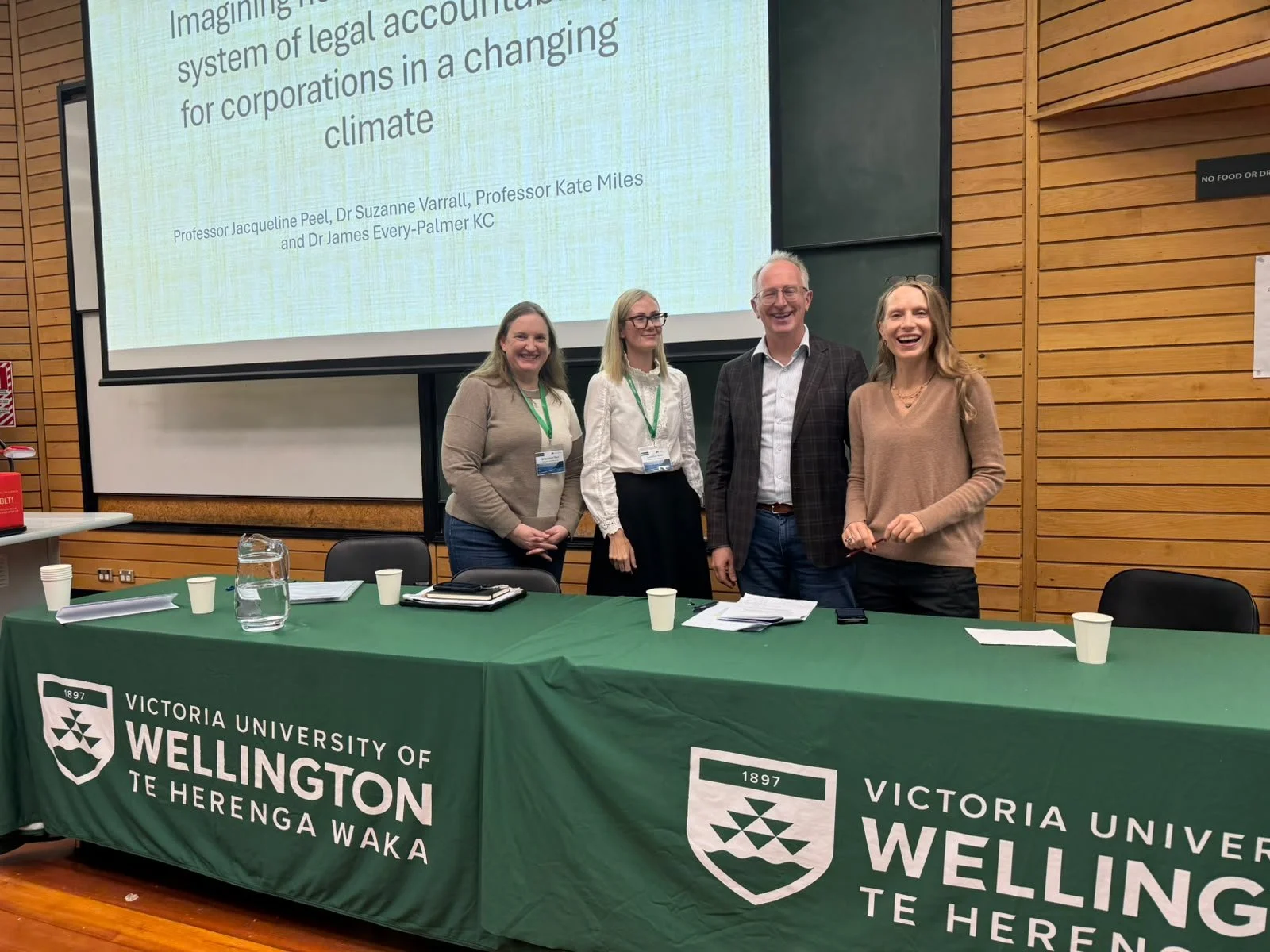
L-R: Prof Jackie Peel, Dr Suzanne Varrall, Dr James Every-Palmer and Prof Kate Miles.
Written by Dr Suzanne Varrall
